Table of Contents
Top 10 Web Development Trends Shaping 2025 and Beyond
The digital landscape is evolving at an unprecedented pace, and web development sits at the heart of this transformation. Businesses, entrepreneurs, and developers must stay ahead of the curve to deliver engaging, secure, and high-performing web experiences. Understanding the latest trends is essential for anyone looking to build or upgrade a website that stands out in a crowded online marketplace.
This comprehensive guide explores the top 10 web development trends shaping the industry in 2025 and beyond. Each trend is explained in detail, supported by recent statistics and actionable steps to help businesses and developers implement these innovations effectively. Whether launching a new project or optimizing an existing site, these insights will empower decision-makers to create future-ready digital experiences.
1. Progressive Web Apps (PWAs)
What Are PWAs?
By blending the advantages of web and mobile technology, Progressive Web Apps offer users speed, reliability, and seamless engagement directly in their browsers. PWAs work offline, load quickly, and can be installed on a user’s device without visiting an app store.
Why PWAs Matter
- According to Google, more than half (53%) of users leave a website if it takes over three seconds to load (Google).
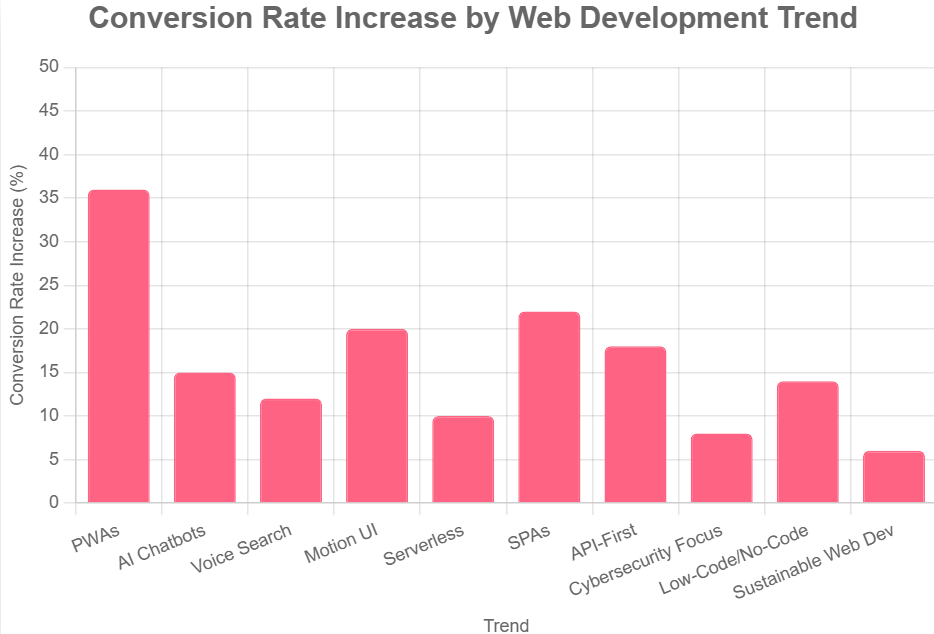
- PWAs can increase conversion rates by up to 36% (Forrester).
Actionable Steps
- Audit your current website for speed and mobile responsiveness.
- Use frameworks like React, Angular, or js to build PWA features.
- Implement service workers for offline functionality.
- Add a web app manifest for installability.
2. Artificial Intelligence and Chatbots
The Rise of AI in Web Development
AI is transforming the way websites engage with their visitors. AI-powered chatbots provide instant support, answer queries, and guide users through the customer journey.
Key Stats
- 80% of businesses plan to use chatbots by 2025 (Business Insider).
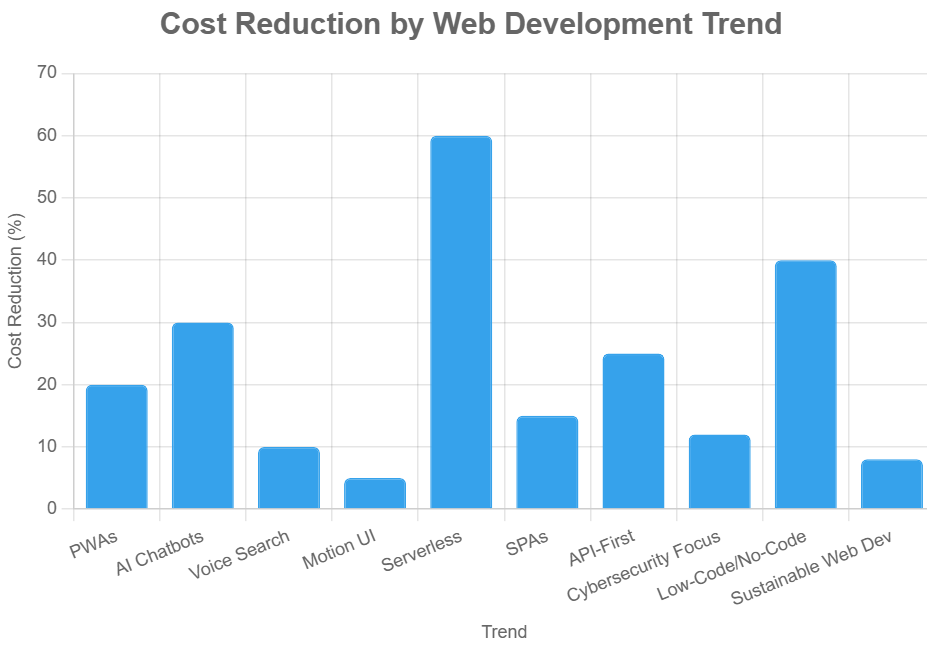
- AI chatbots can reduce customer service costs by up to 30% (IBM).
Actionable Steps
- Integrate AI chatbots using platforms like Dialogflow or Microsoft Bot Framework.
- Utilize frequently asked questions and customer information to instruct bots for tailored replies.
- Monitor chatbot performance and update scripts regularly.
3. Voice Search Optimization
The Shift to Voice
As smart speakers and voice assistants become increasingly widespread, it is essential to enhance websites for voice search optimization. Voice queries are more conversational and often longer than typed searches.
Key Stats
- 58% of consumers use voice search to find local business information (Search Engine Watch).
- By 2025, voice searches are expected to account for 50% of all online searches (Comscore).
Actionable Steps
- Use natural language and question-based keywords in content.
- Optimize for featured snippets and local SEO.
- Ensure website speed and mobile-friendliness.
4. Motion UI and Microinteractions
Enhancing User Engagement
Motion UI employs animations and transitions to lead users, deliver responses, and craft unforgettable experiences. Microinteractions—small, interactive animations—make websites feel more dynamic and intuitive.
Key Stats
- 88% of users are more likely to stay on a site with engaging animations (Adobe).
- Websites with microinteractions see a 20% increase in user engagement (UX Collective).
Actionable Steps
- Incorporate subtle animations for buttons, menus, and loading indicators.
- Use libraries like Framer Motion or GreenSock for advanced effects.
- Test animations for performance and accessibility.
5. Serverless Architecture
What Is Serverless?
With serverless architecture, applications can be developed and deployed without the burden of server management. Cloud providers handle scaling, maintenance, and security, enabling faster development and reduced costs.
Key Stats
- The serverless market is projected to reach $21.1 billion by 2025 (MarketsandMarkets).
- Companies adopting serverless report a 60% reduction in development time (O’Reilly).
Actionable Steps
- Consider adopting serverless technologies such as AWS Lambda, Microsoft Azure Functions, or Google Cloud Functions.
- Identify parts of your application that can be offloaded to serverless functions.
- Monitor usage and optimize for cost efficiency.
6. Single Page Applications (SPAs)
The SPA Advantage
Single Page Applications load a single HTML page and dynamically update content as users interact. This approach delivers faster, app-like experiences and reduces server load.
Key Stats
- SPAs can improve page load times by up to 50% (Google Developers).
- 67% of developers prefer SPAs for new projects (Stack Overflow).
Actionable Steps
- Use frameworks like React, Angular, or Vue.js to build SPAs.
- Implement client-side routing for seamless navigation.
- Optimize for SEO using server-side rendering or pre-rendering.
7. API-First Development
Building for Integration
In API-first development, the focus is on designing strong APIs before constructing the frontend. This approach enables seamless integration with third-party services, mobile apps, and IoT devices.
Key Stats
- 83% of web traffic is API-driven (Akamai).
- Companies using API-first strategies launch products 2x faster (Postman).
Actionable Steps
- Design RESTful or GraphQL APIs with clear documentation.
- Use tools like Swagger or Postman for testing and collaboration.
- Ensure APIs are secure, scalable, and versioned.

8. Cybersecurity and Privacy
The Security Imperative
With cyber threats on the rise, robust security measures are non-negotiable. Users expect privacy and data protection as standard.
Key Stats
- 43% of cyber attacks target small businesses (Verizon).
- 85% of consumers won’t do business with a company if they have concerns about its security practices (PwC).
Actionable Steps
- Implement SSL certificates and HTTPS.
- Use secure authentication (OAuth, 2FA).
- Regularly update software and monitor for vulnerabilities.
- Comply with privacy regulations like GDPR and CCPA.
9. Low-Code and No-Code Development
Democratizing Web Development
Low-code and no-code platforms empower non-developers to build websites and applications using visual interfaces. This accelerates digital transformation and reduces reliance on specialized talent.
Key Stats
- The low-code market is expected to reach $65 billion by 2027 (Forrester).
- Gartner predicts that by 2025, 70% of new business applications will be built using low-code or no-code platforms.(Gartner).
Actionable Steps
- Evaluate platforms like Webflow, Bubble, or Wix for rapid prototyping.
- Train team members on using visual development tools.
- Integrate low-code solutions with existing systems via APIs.
10. Sustainable Web Development
Building for the Planet
Eco-friendly web development prioritizes minimizing the ecological footprint of websites. Efficient coding, green hosting, and optimized assets contribute to lower energy consumption.
Key Stats
- The internet accounts for 3.7% of global greenhouse emissions (The Shift Project).
- Optimizing images and code can reduce website energy use by up to 60% (Website Carbon Calculator).
Actionable Steps
- Optimize images, videos, and code for faster load times.
- Choose eco-friendly hosting providers.
- Minimize third-party scripts and unnecessary plugins.
Educate users and stakeholders about digital sustainability.
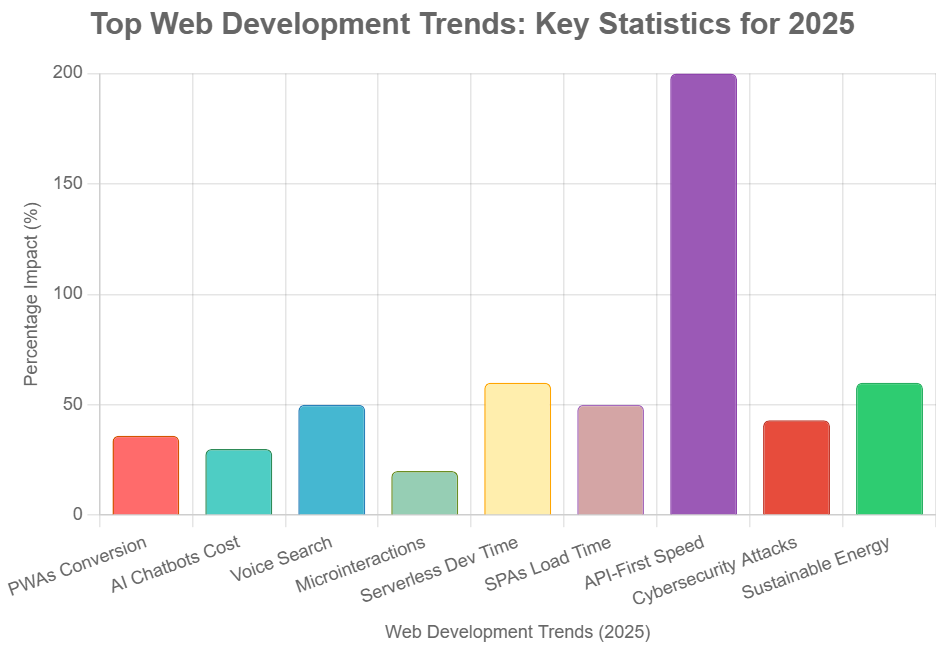
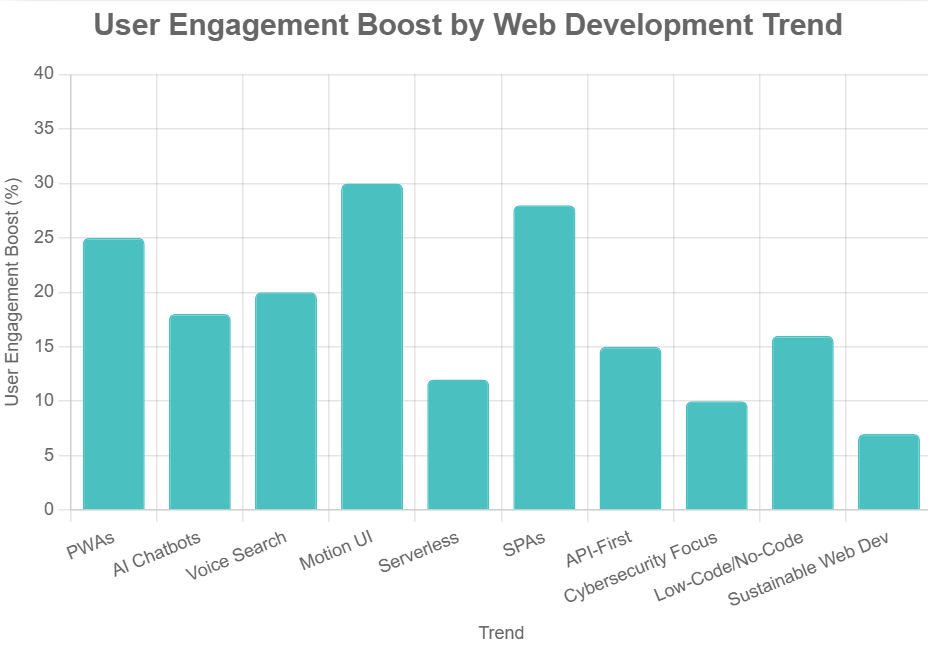
Visualizing the Trends: Charts and Stats
Action Plan: Implementing the Top Web Development Trends
1. Assess Current Website:
Perform a thorough assessment to pinpoint opportunities for enhancement and embrace emerging trends.
2. Prioritize Trends Based on Business Goals:
Align trend adoption with strategic objectives such as user engagement, cost reduction, or sustainability.
3. Develop a Roadmap:
Create a phased plan to implement selected trends, starting with quick wins and moving to more complex initiatives.
4. Invest in Training and Tools:
Upskill teams and invest in the necessary frameworks, platforms, and security measures.
5. Monitor and Optimize:
Track performance metrics, gather user feedback, and iterate to maximize the impact of each trend.
Case Studies: Real-World Impact
Case Study 1: Retailer Adopts PWAs and AI Chatbots
A leading online retailer implemented a Progressive Web App and integrated an AI-powered chatbot. The result was a 28% increase in mobile conversions and a 40% reduction in customer service response times.
Case Study 2: Service Provider Embraces Voice Search and Motion UI
A local service provider optimized its website for voice search and added microinteractions. Organic traffic grew by 22%, and average session duration increased by 35%.
Case Study 3: SaaS Startup Goes Serverless and API-First
A SaaS startup migrated to a serverless architecture and adopted an API-first approach. Development cycles shortened by 50%, and the platform scaled seamlessly during peak demand.
Frequently Asked Questions
How can businesses choose which web development trends to adopt?
Evaluate trends based on business goals, target audience, and available resources. Conduct a comprehensive evaluation to identify areas for improvement and adopt new trends as they arise.
Are these trends suitable for small businesses?
Absolutely. Many trends, such as low-code development and PWAs, are accessible and cost-effective for small businesses.
What is the recommended frequency for updating a website to ensure it remains up-to-date?
Regular updates are essential. Review and refresh your website at least quarterly, and monitor emerging trends annually.
What is the biggest risk of ignoring web development trends?
Falling behind competitors, losing user engagement, and exposing your business to security vulnerabilities.
Conclusion
The field of web development is continually evolving, bringing forth fresh trends each year. Staying informed and taking action on these trends is essential for businesses aiming to deliver exceptional digital experiences, drive growth, and maintain a competitive edge. From Progressive Web Apps and AI chatbots to sustainable web development, each trend offers unique opportunities to innovate and connect with users in meaningful ways.
For expert guidance and tailored web solutions, visit ravens digital. Embrace the future of web development and position your business for long-term success.
Leave a Reply