A domain isn’t merely an online address; it’s the digital handshake that introduces your brand to the world. It shapes perception, fuels credibility, and often determines whether a visitor decides to stay, click, or bounce. When you sit down to compare possible domain names, you’re actually deciding how customers will find, remember, and trust your business.
At this point in your company’s evolution, you already recognize the value of an online footprint. The next move is to fine‑tune that footprint by selecting a domain that mirrors your objectives, market position, and long‑term vision.
Below is a complete, easy‑to‑follow framework that covers branding, SEO, technical, and legal angles—and shows how the experts at Ravens Digital can accelerate the process.
Why a Thoughtful Domain Hunt Matters
Before diving into the “how,” let’s clarify the “why.” Your chosen URL will:
- Project your brand across the web
- Signal trustworthiness to prospects and partners
- Influence search‑engine rankings
- Aid word‑of‑mouth and recall
- Impact conversion rates
A clumsy or ambiguous domain can bewilder users, sabotage SEO, and dilute brand equity. Conversely, a well‑vetted domain positions you as polished, reliable, and easy to locate. Take the time you need; this isn’t a decision to rush.
Step 1 – Pin Down Your Brand Blueprint
Before you start vetting names, answer these foundational questions:
- What tone does your brand speak in? (playful, authoritative, innovative…)
- Who are you trying to reach? (demographics, industry, geography)
- What feeling should the name evoke? (confidence, excitement, comfort…)
- Is your identity local, national, or global?
Your domain should be a natural extension of this identity.
Examples
- A fintech startup may gravitate toward a sleek, futuristic name.
- A boutique law firm might opt for a formal, authoritative phrase.
- A regional plumbing service could embed its city or state into the URL.
Without a clear brand compass, you’ll be guessing rather than strategizing.
Step 2 – Brandable vs. Keyword‑Rich: Find the Balance
When you begin listing possibilities, you’ll encounter two primary camps:
Type | Typical Traits | Upsides | Drawbacks |
Brandable | Invented, catchy, often a made‑up word | Strong brand ownership, easier trademark, unique identity | Needs more marketing to explain purpose |
Keyword‑Focused | Contains industry‑relevant terms | Instantly tells what you do, may aid SEO | Can feel generic, harder to differentiate |
A hybrid—think “SnapFit.com” or “EcoBuild.tech”—often delivers the best of both worlds: memorability plus relevance.
Step 3 – Keep It Short, Simple, and Sticky
Run each candidate through this quick checklist:
- Spellability: Can a user write it correctly after hearing it once?
- Pronounceability: Does it roll off the tongue?
- Memorability: Will it stick in a conversation?
- Avoidance of confusing characters: No hyphens, numbers, or obscure spellings.
If you find yourself needing to spell it out letter by letter, it’s probably not the right fit.
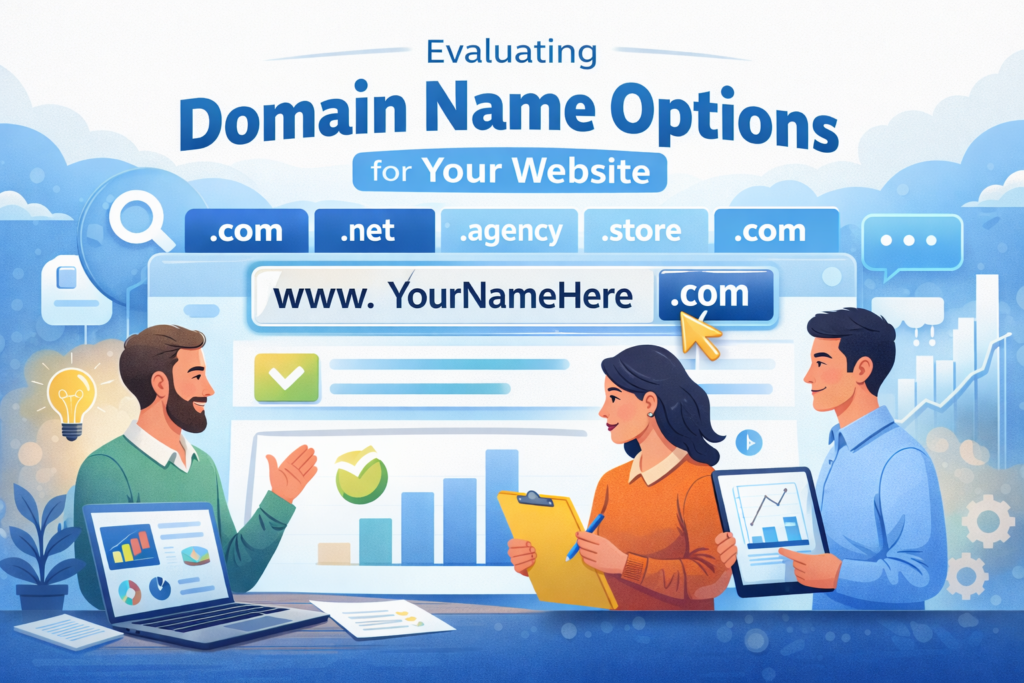
Step 4 – Pick the Right Extension (TLD)
The suffix of your domain still carries weight.
- Universal favorites: .com (most trusted), .net, .org
- Industry‑specific options: .tech, .store, .digital, .agency, etc.
While .com remains the safest long‑term bet, a niche TLD can reinforce a specialized brand—provided the name is still available in .com for future flexibility.
Step 5 – SEO Considerations
Search engines treat domains as one of many ranking signals. When you evaluate options, keep these points in mind:
- Steer clear of overly‑optimized, spammy keywords.
- Check the domain’s history for past penalties or spam associations.
- Align the name with your sector without stuffing it with exact‑match phrases.
- Visual appeal in SERPs: A clean, professional‑looking URL encourages higher click‑through rates.
Remember, a strong domain boosts CTR, which in turn helps rankings.
Step 6 – Dig Into the Domain’s Past
Before you lock in a name, perform a thorough background check:
- Previous owners and any prior branding.
- Archived website content using the Wayback Machine.
- Backlink profile for low‑quality or spam links.
- Blacklist status in Google’s Safe Browsing or other security tools.
Acquiring a “clean” domain protects you from inheriting hidden SEO baggage.
Step 7 – Legal & Trademark Clearance
Skipping the legal vetting can cost you dearly later.
- Search USPTO (or your local trademark office) to confirm the name isn’t already registered.
- Run a broader internet search for similar brand names in your niche.
- Assess the risk of confusion with existing businesses.
A domain that infringes on another’s trademark can lead to costly disputes or forced rebranding. Secure your legal footing from day one.
Step 8: Long-Term Viability Assessment
When considering potential domains, adopt a future-oriented perspective. Reflect on:
- How this name will serve your business in five or ten years.
- Whether it confines you to a narrow service range.
- If it’s anchored to a single product you might eventually outgrow. A domain that incorporates a specific product can make future diversification feel awkward. Opt for a web address that can evolve alongside your company’s growth.
Step 9: External Feedback & Perception Check
Before committing, validate your choice beyond your immediate team:x
- Present it to colleagues for honest reactions.
- Survey target customers or focus groups.
- Say it aloud—ensure it’s easy to communicate.
- Use quick social polls to gauge wider appeal. Internal enthusiasm doesn’t always translate to public appeal. External perception shapes credibility.
Step 10: Cross-Platform Brand Consistency
A unified name across all digital touchpoints reinforces brand recognition. While selecting your domain, simultaneously verify:
- Availability of matching handles on Instagram, LinkedIn, Facebook, and X (Twitter). Consistency in your online identity builds trust and makes your brand easier to recall.
Common Pitfall:
- Picking spelling trends that will soon seem dated.
- Adding hyphens or numbers without clear purpose.
- Selecting names that are phonetically confusing.
- Making a rushed decision without due diligence. Domain selection is a strategic choice, not a spontaneous one.
How Ravens Digital Elevates Your Domain Strategy
Choosing a domain is about laying a strategic cornerstone, not just securing an address. Ravens Digital (http://ravensdigital.com/) provides a structured, expert-led process:
- Brand Alignment Analysis: We map your vision, audience, and market position to ideal domain structures.
- Competitive Landscape Review: We dissect competitor domains to uncover differentiation opportunities.
- SEO-Focused Evaluation: We assess options for keyword relevance, search potential, and long-term ranking viability.
- Technical & Historical Due Diligence: We investigate past penalties, backlink profiles, and technical risks of any domain.
- Scalability Planning: We ensure your final choice accommodates planned business expansion.
A Practical Framework for Domain Selection
Follow this actionable sequence:
- Clarify your brand’s future trajectory.
- Generate a wide list of potential names.
- Narrow by simplicity, ease of spelling, and memorability.
- Evaluate SEO and keyword potential.
- Consider the most appropriate extension (.com, .io, etc.).
- Conduct trademark and legal clearance.
- Investigate the domain’s historical record.
- Gather feedback from a sample audience.
- Secure matching social media handles.
- Register promptly upon decision. This methodical approach mitigates expensive oversights.
The Subconscious Influence of Your Web Address
Users instantaneously form judgments based on your domain:
- It signals legitimacy and professionalism.
- It influences click-through decisions. A strong domain boosts brand recall, fosters trust, and increases conversion rates. Therefore, selection must blend marketing psychology with practical availability checks.
The High Cost of a Poor Fit
Companies often rebrand later because their initial domain:
- Became a straitjacket for new services.
- Proved too cryptic or hard to spell.
- Was overly generic or no longer representative. Rebranding extracts a heavy toll in lost SEO equity, diminished brand recognition, and wasted marketing investment. Thorough evaluation now prevents massive future costs.
Strategic Foresight: Projecting Your Future
While assessing options, simulate scenarios:
- Entering international markets.
- Launching diverse product lines.
- Running large-scale ad campaigns.
- Forming strategic partnerships. Does your proposed domain remain robust and relevant in these contexts? Forward-thinking is non-negotiable.
Conclusion: Choose with Strategic Confidence
Selecting a domain is a pivotal moment in building your digital presence. It transcends finding an available string of characters—it’s about securing a memorable, scalable, and strategically sound asset that aligns with your core goals.
The ideal domain will:
- Solidify your brand identity.
- Build immediate and lasting trust.
- Support your SEO objectives.
- Amplify marketing efforts.
- Enable unfettered growth.
Expert guidance transforms this critical task from a guess into a strategic victory. At Ravens Digital, we integrate branding, SEO, technical analysis, and growth strategy to help you confidently select a domain that empowers, rather than limits, your vision. Your domain is a foundational digital asset—choose it with deliberate strategy.
Leave a Reply